A Look at Tight & Weak Muscles
May 9, 2016
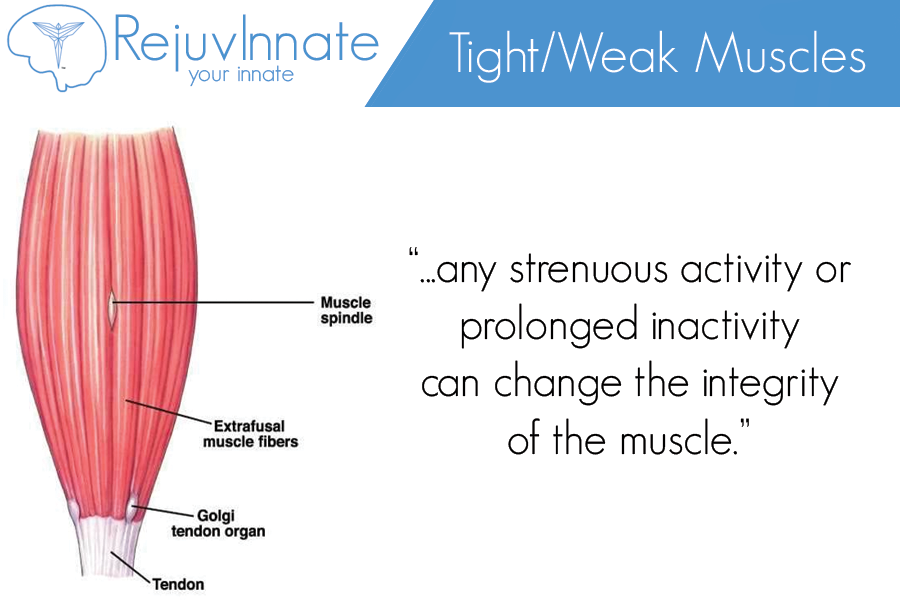
When muscles tighten up or become weak, it can be a real pain. You lack range of motion, you feel pain, and it can become extremely frustrating when it doesn’t go away. This can impact your workouts, your lifestyle, and your health. Understanding how the body and muscles work will help prevent these limiting factors from affecting your life. Things to consider for a tight or weak muscle will be spindle cells, golgi tendon organs (GTOs), and origins/insertions (O/I), because any strenuous activity or prolonged inactivity can change the integrity of the muscle. Here is quick summary of what actions these three components have on a muscle.
Spindle Cells
These are located in the belly of a muscle. When a muscle is being stretched, there is
an automatic response to contract the muscle to protect it from being overstretched
and torn.
An example would be when you are doing a bicep curl with weights. When you have
done a full curl and you begin to drop the weight back down, you are essentially
stretching the muscle back to its originally state. During the process of dropping the
weight, your bicep is still controlled and contracted. That is because your spindle
cells are creating a response to protect your muscle from injury.
Golgi Tendon Organs
These are located in the tendon of a muscle. Golgi tendon organs provide a tension
reflex. When there is too much tension on a muscle, these send a signal to your body
telling it to shut off the muscle so that it does not become damaged.
An example of this would be trying to do a bicep curl with weights that are too heavy for
you. When you try and do a curl, you might be able to get enough contraction to lift
it a little, but the golgi tendon organs will feel this tension and send a response to
shut down the muscle before there is any damage done.
Origins/Insertions
This is simply where the muscles are attached. It is important to understand where
each muscle attaches in order to get a full analysis of where your body may be
breaking down.
Tight Muscles
When we think about a tight muscle, we think about the lacking range of motion that
occurs and maybe even some pain involved with it. Tight muscles can be a result of a
muscle in a shortened state for a long period of time. For example, sitting at work all
day or excessively working out your hip flexors without working out the antagonist
muscles. Either one of these examples causes the hip flexors to become shortened and tight. One of the hip flexor muscles known as the psoas attaches from the
lumbar (low back) spine to the thigh. When this muscle becomes tight, it pulls the
spine forward which leads to a lot of low back issues such as general pain, sciatica,
and disc herniation.
Usually these symptoms become noticeable when the issue has worsened. Your
body does such a great job protecting itself, however compensation after
compensation can only get your body so far. Fixing the cause of the problem is vital
before the symptoms become unbearable.
Weak Muscles
With tight muscles come weak muscles. These muscles are weak because there is
minimal activity or contraction in them. Rather than becoming shortened, the
muscles are lengthened. This changes the integrity of the muscle, which will lead to
postural distortions and pain. Think about your ankle for a moment. When certain
muscles that move the ankle become weak, your ankle has less stability leading to
frequent ankle sprains and injuries. Making sure that proper muscle activation and
strength is crucial in sports and your daily life.
The Solution
There are many ways to balance the body. Certain physicians focus on the tight
muscles. They find the tight muscles and use a technique called myofascial release
where they manipulate the fascia so that the muscle and fascia work in unison.
Other practitioners (like us) work on activating the weak muscles. With proper
activation, the body no longer compensates eliminating your tight muscles. The
results are noticeable almost immediately. How does this work? Knowing how to
properly reset the spindle cells, GTOs, and O/I allows the muscle to regain optimal
activation.
Whether it’s working on the tight muscles or activating the weak muscles, do not
wait for your symptoms to worsen. Find a practitioner that can fully analyze your
spine and muscles in order to live the lifestyle you want. Pain is usually the last
straw so do not wait to get treatment. When it comes down to fixing the problem,
seeking a chiropractor, osteopath, or physical therapist can help in many ways. At
times, having a combined team of a chiropractor and physical therapist can be
extremely beneficial.
Innately Yours,
Drs. Andy & Victoria